Alert: Your browser does not support full functionality of our app and you may experience certain errors. We recommend that you use Chrome, Firefox or Internet Explorer Edge instead.
Write a presentation of the project in Aixeta and what you offer to the patrons of the page (cover-presentation).
Add photos to the gallery that define your project. Also a photo and/or video for the cover!
Write a more general description of the project, making a personal historical summary or of the project (info-biography).
Include links to the project's website and/or social networks.
Add subscription levels and define what rewards are offered for each level.
If you want, you can have it in Catalan, Spanish and/or English.
Finally: request the activation of the page. We will do a final review and you will receive suggestions. When it is ready, we will publish it!
It is essential to have a clear promotion strategy (social media, live, email, etc.) to attract patrons to your page. Aixeta will also help you with this. It is the responsibility of each creator to fulfill the commitments to patrons that are explained in the subscription levels. If you can find and encourage your followers, Aixeta will work for you!
Once inside the platform, you can add information to the cover, info and subscription levels, as explained below. While you are creating the page, it is only visible to yourself. Once you are satisfied with the content and request its activation, we will review it and make it public.
The cover
The cover is the page where your publications appear, it is the cover of your content on Aixeta. The cover text is your presentation, your business card: it explains what you do and what you will offer on the Aixeta page. What is it that you create? Why is it interesting? Why would someone want to follow you? You can edit the different contents by clicking the pencil next to the name. There are three text areas on the cover: the title, the summary (line under the title) and the presentation. When you click the pencil, you will see that the text can be edited. Click on the check mark to accept the changes or on the X to undo them.
Text editing
One simple thing, but very important: the title and summary should be short!
Short description
If you want to add the text to the presentation in another language, you can choose that language from the menu at the top right and proceed to edit the text again, clicking the pencil and accepting the changes. Aixeta always shows the texts in the language that the user has selected (and if there is nothing in that language, then in the one that is there). We explain more about how to offer a multilingual page later.
Choice of languages
You can include images in the Gallery by clicking on the plus +. You can upload photos of yourself, performances, album covers, books, events, your logo… whatever you want. The images should also give an idea of the type of content you will share on your page on Aixeta. They should also be attractive! You can upload many images, but only 12 are displayed at a time on the cover page. You can rearrange or delete them by selecting the Settings and options option, then Images from the menu that comes out of the round (direct link).
Add images
The information
You've explained what you do, now you have to explain WHO YOU ARE. That's why the Info page is more biographical. This is where you explain who you are or who you are in the group, what your name is and why, what your education and background are, what projects and collaborations you've done so far, future projects, etc.
To do this, click on the pencil next to Biography. When you're done, click on the check mark to save your changes. To add another language, choose the desired language from the menu and edit the information again. There are more details about multilingual pages later.
It is essential to upload a photo of yourself. To do this, click on the plus + button on the right. You can upload as many photos as you want, but only four are visible at once on the info page. You can manage which ones by choosing Settings and options, and Images from the menu (direct link). There are more details on how to manage images later.
It is essential to put the links to all your social networks, being able to add the website, the profiles of Youtube, Spotify, Tik Tok and others. To do this, click on the plus button + at the bottom of the page, next to Links: a box will appear where you can type the text that identifies the link and the URL. The first five links will also be displayed at the top of the header of your page, in the form of icons.
Introduction of links
Subscription levels
Subscription tiers help define the relationship between you and your subscribers. Basically, you’re saying, “For this amount of money, I’ll give you this or that.” To create subscription tiers, you need to think about what you want to offer your audience, how you want to connect with them. It’s not just about selling them an album or a t-shirt, it’s about finding ways to share and connect.
Subscription models
There are many ways to target subscription levels. In general, the idea is to create a community around your project, but there are many ways to do it. The important thing is that it reflects the way you are and act. It is also important that your followers find something on your page that encourages them to sign up, it does not have to be something tangible: something that makes them feel involved in your project.
Exclusive or first-hand information or content.
Personal content, off-camera/microphone.
Special access to tickets or seats, to an exclusive newsletter for patrons...
Interactive, personalized or thank-you rewards: dedicate songs or videos to subscribers, small group meetings (virtual or in-person), offer the opportunity to attend rehearsals, backstage, special meetings for subscribers, book clubs, hold small-format concerts (in-person or virtual)... Anything participatory (surveys, raffles, etc.)!
Reward ideas
We have created different documents with ideas for rewards that you can give, depending on the type of project. It is important that you choose things that make the most sense to you, that do not cost you too much work/time/resources, and that fit within the value of the subscription level. Don't give too much or too little. You can see the creator material related to reward ideas at this link.
Cumulative or independent?
Subscription levels can be cumulative or independent (there is a button at the top of the list of levels). If they are cumulative, subscribers to higher-priced levels will also have access to content made available to lower subscription levels. If the levels are independent, only subscribers to a particular level will have access to content published in that level.
How many levels?
We recommend between 3 and 5 levels at varying prices, starting with a level of €2 (practically affordable for everyone) and ending with a level higher than you think anyone would ever subscribe to (€25?, €50?, more?). Who knows if there are people with money who want to be part of your project and who want to sponsor you in a special way?
Create subscription levels
There are two ways to create subscription levels. The easiest way is to go to your Subscriptions tab and click the button that says "Add". Before you do, you'll see a turquoise box displayed. Click the pencil to add a general description to the subscription levels page to encourage your followers to sign up. If you don't want to write anything, this box won't be displayed.
Add subscription level
Introductory text
Each subscription level has a name, an amount of euros, and a description. Once you have subscribers, you can no longer change the amount (it wouldn't be fair to the subscribers). You can delete levels and create new ones.
If a creator wants a patron to have had a certain amount of time before being able to receive any rewards —which is quite common— this requirement must be made explicit in the text of the Subscription Level and must be managed manually. For example: “To be able to participate in the quarterly meetings with subscribers, you must have been a patron for 3 months previously.”
When you're finished defining your subscription level, click the Create Subscription Level button. You can also create and edit subscription levels on the Subscription Levels page.
Personalized image and welcome message
In each subscription level you can customize two elements that, on the one hand, will give aesthetic consistency to your page and, on the other, will build loyalty among your patrons and humanize the relationship you want to have with them.
Once you have entered the name of the Subscription Level, the monthly price, the annual price (if you consider it appropriate) and the corresponding description, you can customize:
The image that will be displayed on your Subscriptions tab. It must be an image with a maximum weight of 3MB. If you do not upload an image, Aixeta will use a default image.
The welcome message, with its subject and the thank you text that you want to send to each new patron.
Cumulative subscription levels
It is important to decide whether you want the levels to be cumulative (subscribers of more expensive levels have access to content published by lower levels). If so, click the Levels are cumulative button.
Subscription tier options
Pause subscriptions
With this option enabled, subscriptions will not be charged. If you stop offering content for a while and do not want to receive financial support, this is a good alternative, as you will not lose your patrons. When you decide that you want to charge subscriptions again, disable this option.
Copy the link of a subscription level
If you want to share the link for a particular subscription level, click the links icon in the Share column and then paste the copied link on social networks, email, etc. When a potential subscriber clicks on the link, they will be invited to subscribe to that level.
Subscription level link
Other contributions: one-time donations
To accept other types of contributions, such as one-time or monthly donations without any reward, click on the corresponding Options button.
Other contributions
Once you have clicked on it, a small screen will open with several options. Activate the turquoise button for "Permetyre donations" if you want users to be able to make free contributions to you. They can be one-time or monthly. The amount given is decided by the patron. You can also highlight this payment method on your Subscriptions page, placing it at the top. To do this, activate the "Highlight" button. As with the subscription levels, if you consider it appropriate, here you can also customize the title, description, image and thank-you message. To do this, click "Edit".
Other Contributions Options
Remove subscription levels
To remove a subscription level, click Remove next to its name. If there are subscribers at that level, they will be automatically unsubscribed.
Publish your creations
Your page revolves around your posts. Like everything on Aixeta, they can be published in Catalan, Spanish and/or English. If you create versions in different languages, the content will be displayed according to the language the user has selected. If that language does not have a translation available, they will be shown the language that is most similar.
Create a post
To create a post, either click on the plus + at the bottom of your cover, or choose Posts from the menu (which comes from the round icon) and then the type of post you want to create. You can create content from:
Text
Image
Poll
Audio
Video
The initial language of the content is the same as the language that your ten selects for the platform (which can be changed with the language menu at the top of the page).
Types of publications in Aixeta
Each post must have a Title and some content in the Content box. You can type text for each post type. You can edit with the tools at the top of the text box. Include links by selecting text and clicking the links icon. Make and undo changes by clicking the arrow buttons on the right side of the window.
Creating a post
Add files to a post
To upload images, audio, and video, click the Add button next to Files. You can also add titles and footers. Once the files are uploaded, you can change their order by dragging the icon to the far left of the file you want to change. Click the Highlight button so that this file is used to identify the post on the front page and in searches on Aixeta. Click Delete to delete the file from the page.
Adding files
Designate the subscription level for the publication
Select the subscription level that will have access to this publication from the Subscription Level menu. You can also make the publication available to everyone by selecting Free. Remember that if you have checked the Subscription levels are cumulative option, giving access to a lower level will also give access to higher levels.
Choosing your subscription level
Add tags to a post
Tags can be added to make it easier to search for content later. You can also specify a summary for the post that will appear next to your page in web search engines (like Google).
Add a summary
The summary is the text that will appear next to your document when it appears in the results of a search engine like Google.
Change the URL of a post
You can change the page address (for example, to simplify it) in the URL box. Once published, it cannot be changed.
Save a draft of a post
You can save a draft of your post at any time by clicking Save Draft. Drafts are saved in the Drafts section of your Posts page. By clicking Preview, you can preview a draft of a page to see how it will look and also copy its URL before you publish it.
Draft
Edit a post
You can always edit a post again, even once it's published. You can also temporarily unpublish it by saving the draft. You can edit it to add more than one language. In the list of Posts, click Edit and then, in the upper right part of the space for editing the text, you will see three links, each corresponding to the three languages available on the platform. You can translate it into each language by clicking on the links for Catalan, Spanish or English. Save the draft or publish the document to save the new version. The image, audio and video files are the same in each language version. Oh, by the way! You can also add images to all types of posts!
Languages
Highlight a post
If you want a post to always be pinned to the top of your Front Page, click Pin to Front Page in the Options menu.
Publish or schedule a post
When you are ready to publish your content, you can click Publish to publish it directly, or you can click Schedule to specify the day and time when it should be published. You cannot select a time in the past. Scheduled documents are saved in the Scheduled list on the Publications page. Once published, they move to the Published list and appear on your front page. Publications that require a subscription will be displayed with a star.
Scheduling a post
Publication frequency
We recommend that you post to your page with some frequency. It doesn't have to be very regular, nor does it have to be on the same day, but it's good to not let too many days go by without posting something.
Delete a post
You can delete a post by selecting Options next to its name on the Posts page and choosing Delete from the menu.
Promote a post
Every time you post new content to your page, you should share it across all of your social media and email lists. The image from the file you marked as “featured” will be used to accompany your social media posts. Remember to include the URL of the new post in all your social media posts so people can go directly to your post.
If your post is open to everyone, the link will take them directly to the post page where they can read, view, listen to, or watch your content. If it’s for subscribers only, those who follow the link will see a notice explaining that they must subscribe before they can access the content. Aixeta will invite them to create an account and enter their payment information before showing them your content.
Each creator defines a series of subscription levels with a description of the rewards subscribers will receive and the price they must pay. Patrons can find the subscription levels by clicking the Subscriptions button on the creator's page. Once inside, you will see the different subscription levels, and you can choose one by clicking the Subscribe! button.
Subscribe button
Subscribers can also unsubscribe freely:
By clicking on “Contributions” in the main menu at the top right (round icon).
By clicking on the creator’s name.
You will see three options: Send them a message, Go to the page, Unsubscribe.
By clicking on “Unsubscribe”, marked in red.
A user can unsubscribe from a subscription
A potential patron will also find the option to subscribe if they click on a post that is only available to subscribers of the corresponding level.
Publication only available for a specific subscription level
Finally, the creator can copy the link for a particular subscription level on the Subscription Levels page to share in their promotional campaigns and help potential subscribers get directly to the subscription screen for a particular level.
Subscription level links
Aixeta does not enforce the terms of the subscription tiers. It is the creator's responsibility to deliver on the promises they have made to their patrons. A patron who is dissatisfied with a creator's rewards can unsubscribe at any time.
Information about patrons
On the Subscription Levels page, you can see a summary table of how many patrons you have and at what levels, and how many posts you have made for each level. On the Patrons page, you see a list of all the creator’s patrons, as well as the subscription level, date of registration, a button to send them a message, and another button to ask for more personal information. Creators can see data about their individual subscribers by selecting Community, then Patrons, from the menu. You can filter the list by subscription level, name, email, etc.
Access to patrons' personal data
To access the patrons' email, postal address and/or telephone number, the creator must request permission by selecting the patron in the list of patrons and clicking See more. There, they will find buttons to send the request to the patron. When the patron gives the go-ahead, the creator will see the corresponding data.
"See more" button
To the right of the box you will see buttons to request access to certain subscriber data: email, postal address or telephone. Each subscriber must give you permission to access this data. Once they have done so, the data appears automatically.
Contact details
Send messages to patrons
The Patron box appears where you can see their profile, name, and history as a subscriber. You can also send them a message using the Aixeta's internal messaging system by clicking Write a message at the bottom left.
Cancel a patron
If you scroll to the bottom of the screen, you will see the option to unsubscribe the patron (inside the Management box). Patrons can always unsubscribe themselves whenever they want, but if you see that a patron has been missing payments for a couple of months and not responding to your emails, or if they are asking you to help them, you can choose to unsubscribe them directly.
Cancel a patron's subscription
Followers without being patrons
People can follow your activity without being your patron. If they click on the heart of your page, they will receive a notification every time you publish something new.
Messaging
You can access the internal messaging system of Aixeta by clicking on the envelope that you will find in the top bar of the window, near the round icon. Here you will see all the correspondence between you and your patrons and between you and the creators of whom you are a patron. To make a new message, click on the plus+ on the far right. You can send messages to a specific patron or to all patrons, to patrons of a specific subscription level, and to all followers of your page (those who have clicked on the heart of your page).
Sending messages
Tips for subscription levels
What can I offer my patrons?
If you are a creator on Aixeta, you can create different subscription levels so that your audience has different combinations of money and rewards to choose from to support you. The more there are, the more diversity there will be. In each subscription level, you define what content you will share, and also the amount in euros that patrons will have to pay monthly to have access to it. You can define as many subscription levels as you want, and they can be for the amount of money and rewards you want. However, from Aixeta we recommend that you create between 3 and 5 subscription levels. We have observed that doing more can be harmful, since it can help generate indecision among your potential patrons. That is why we advise you to take into account and deeply evaluate the number of subscription levels you offer. It is best that they are specific and that they encourage your followers. You can offer different types of rewards: we'll help you break it down right away!
Create a content library
There are many ways to offer content to attract subscriptions. You can use your Aixeta page as a library of all your content, both new stuff and old stuff that new subscribers don’t know yet.
Or you can use your Aixeta page to offer longer, more complete, detailed, in-depth content… while offering a sample or a shortened version in the open, or at a lower subscription level. For example, you might publish a segment of an interview where you tell interesting stories about the different languages of the world. You could offer a longer half-hour version, with more details, for subscribers. Or maybe you have a video version. Or a guide for teachers and professors so they can use it in the classroom.
Also popular is content offered as a preview. First give subscribers immediate access, and a few days later make the same content available to everyone.
Create community
Your page on l'Aixeta can be a hub for community activity, activism, neighborhood projects, or something else shared. Rewards can be meetups, questions and answers, discounts on events you organize, special workshops for subscribers, articles on the topic that unites you... The key is to create a community of people interested in the same topic.
Share knowledge
You can offer your expertise and experience in creation. Maybe you know how to crochet, garden, make murals, paintings, websites, play the guitar or speak Danish, maybe you know the history of Mallorca, or the Valencian Country, or the best place to surf in winter. On l'Aixeta you can offer your knowledge. and, most importantly: share it. You can publish short lessons open to everyone and offer more extensive lessons only for subscribers, with the option to solve doubts, for example. You can offer tutorials of the most complicated techniques, explain tips and details in writing, by audio or with video. Your page on l'Aixeta can be a good resource for anyone who wants to learn what you already know.
Offer a relationship with your subscribers
You can use your page on Aixeta to create a connection with your followers. You can give them access to you, letting them ask you questions about the things you create, you can publicly recognize them with thanks, you can share your life behind the scenes (your creative process, your personal life, your worldview), you can have virtual conversations one-on-one or in groups (a virtual or in-person book club, attending rehearsals, having dinner or having coffee), you can offer personalized messages (sending postcards or connecting on social media)...
Subscriptions with variable prices
You can also leave all content open or available for the lowest subscription level, and then create multiple subscription levels with the same rewards at different prices, essentially allowing subscribers to choose the level they want to support you with, regardless of the rewards. This is a very popular option.
Service/product
You can use Aixeta to offer a product or service, a monthly call, business advice, individual or group classes... For example, it can be a means to sell books, magazines, CDs... and share them with your community.
Surprises
Another possibility is to offer surprise content – personal or random things –, things that are not part of any reward, but that arouse the curiosity of a potential subscriber.
Receive generic support
It may also be possible that, due to the specificities of your cultural, communication, sports, informational project, etc., you do not see clearly how to link the rewards you can offer with the contributions of your patrons. In other words: you may not be interested in offering specific rewards, either because your proposal does not allow you to do so, or because it does not fit with your reality. A mechanism that works very well and is very well received is that of open subscription levels, without offering any specific exchange or consideration, where you can request direct support for your project in a generic way, and you commit, nothing more and nothing less, to being able to continue carrying out your work thanks to the involvement of your patrons.
We hope these ideas help you think about what rewards you want to offer. The most important thing is to know your audience, what they value and what they want from you, and to post things with some regularity. The only limit is your imagination. See you at Aixeta!
How to attract patrons to a page
Why does it cost so much to have patrons?
You open a page on Aixeta. You have written a very powerful presentation on the Cover page about everything you will offer, you have written a description of your creative path in the Info section, you have chosen some photos that evoke all your creativity and, the most difficult thing of all: you have thought of some very attractive rewards in exchange for a little money from potential subscribers.
And then you publish something, a song, a piece of writing, an image, whatever. And you wait a while, and you don't get any response. And maybe you publish something else. And you wait a little more. And a couple of days pass, and maybe you get your first patron, or maybe not, and great, but not hundreds either, and everything seems very slow. And you start to think that maybe this doesn't work, or that it only works if you have millions of followers, or that it only works on Patreon, or you know what.
But the problem is not the followers or the few differences between Aixeta and its American competition. We have been analyzing all the pages and campaigns that have been made in Aixeta, so we can explain to you what works best to attract patrons. Here we will talk about the use of social networks and some examples, but remember that any channel through which you communicate with your environment is important to achieve good results (instant messaging channels, newsletters, emails, your blog, your website, your public interventions, interviews or appearances in the media, etc.).
A case of success: the writer Pol Sedierta
In this sense, we want to tell you about the case of the writer Joan López Rovira, alias @PolSedierta (on Twitter and Instagram) and how he has used social networks to achieve this. His page on Aixeta is called Valruspines Edicions. He has about two thousand followers on Twitter and less than 500 on Instagram.
Joan had a page on Patreon when he heard about Aixeta and, preferring a local platform, decided to make the change from the beginning, opening his page in January 2019. It is understood that the first 12 patrons on Aixeta came from his page on Patreon, which he closed once he had made the transition to Aixeta. After the first wave, mostly of readers who were already known to the author, he gradually gained more patrons over the following months: one more patron in April, June and December 2019, and one more in January 2020.
In March, Aixeta announced the #BequesALaCreació. As you know, there are two grants, one of €500 and one of €300, that we give to two creators who meet very specific requirements: having a page up and running for at least two months, having a minimum of 20 publications and having attracted at least 50 patrons. The requirements were designed to help creators with active pages.
Start of the campaign to attract new patrons
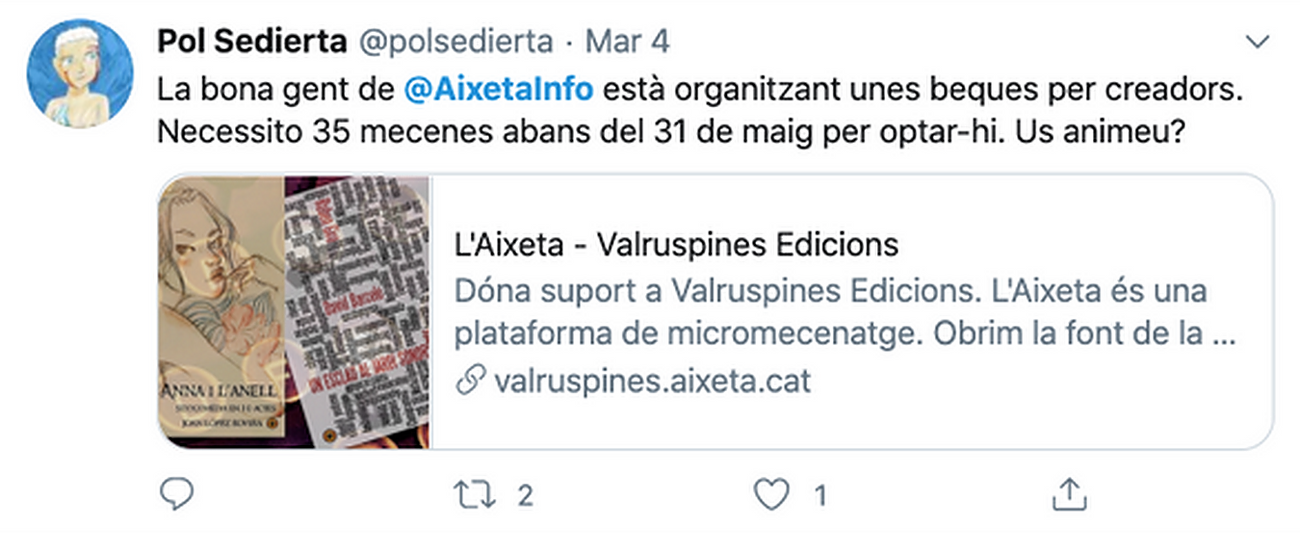
Joan saw the initiative and decided to start a campaign to attract these 50 patrons. There were 35 missing. He made his first tweet asking for subscribers on March 4, shortly after we announced the grants:
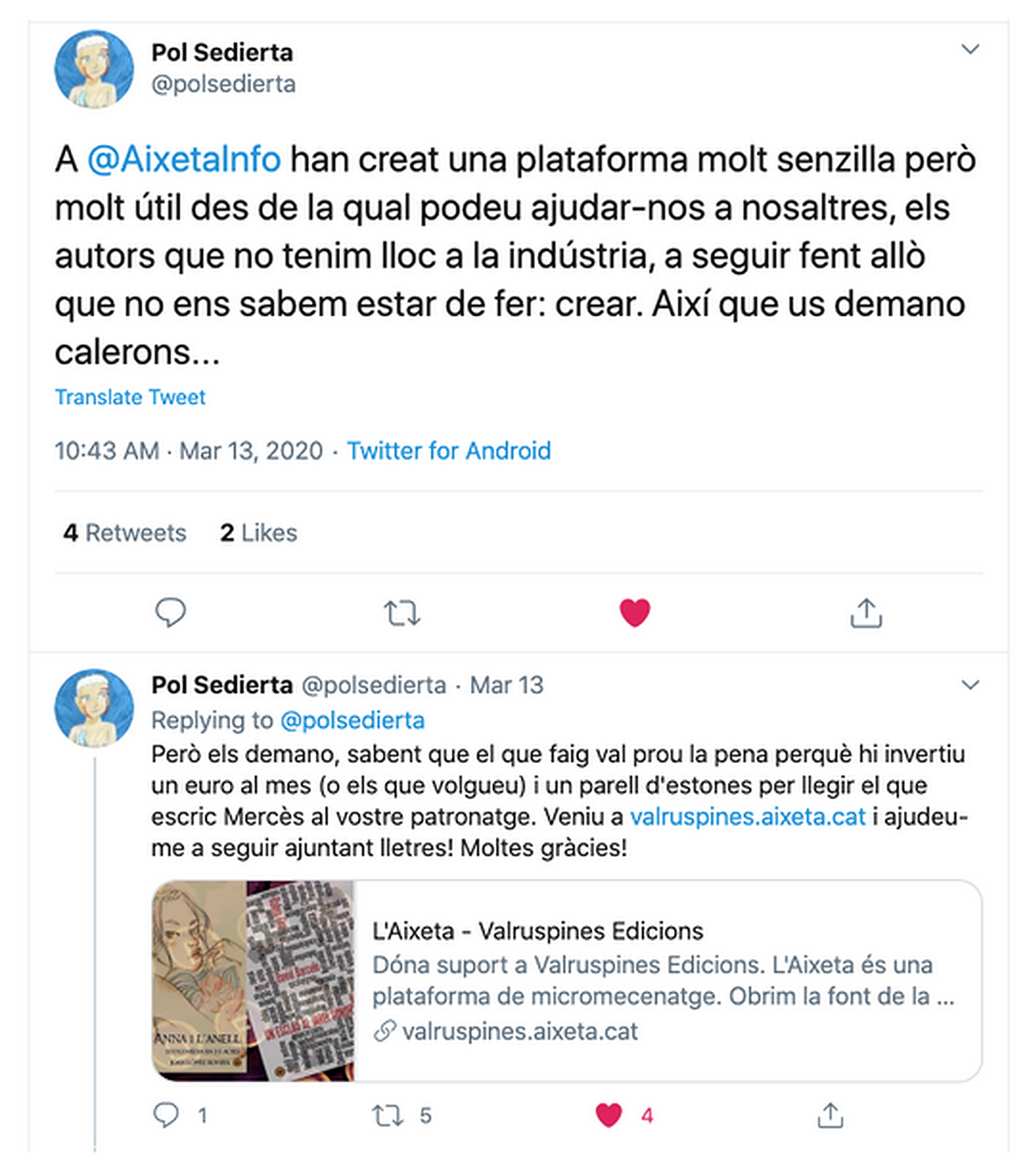
Notice that he incorporates two important elements in this first tweet: he explains the goal (35 patrons before May 31) citing Aixeta and asks for a subscription (“Are you excited?”). And he adds a link to his page. But it didn’t have much of an impact. Two retweets, and no one became a patron that day. Ten days later, he tries again. And we don’t know if it’s because he finds the right person or what, but this time he does succeed, and one person signs up to be his patron.
Notice that this time there are two tweets explaining much more about how Aixeta works and how the continuous micro-funding system works, thanking you, and finally, again, putting the link to the page. Don't try again until two weeks later, on March 29th.
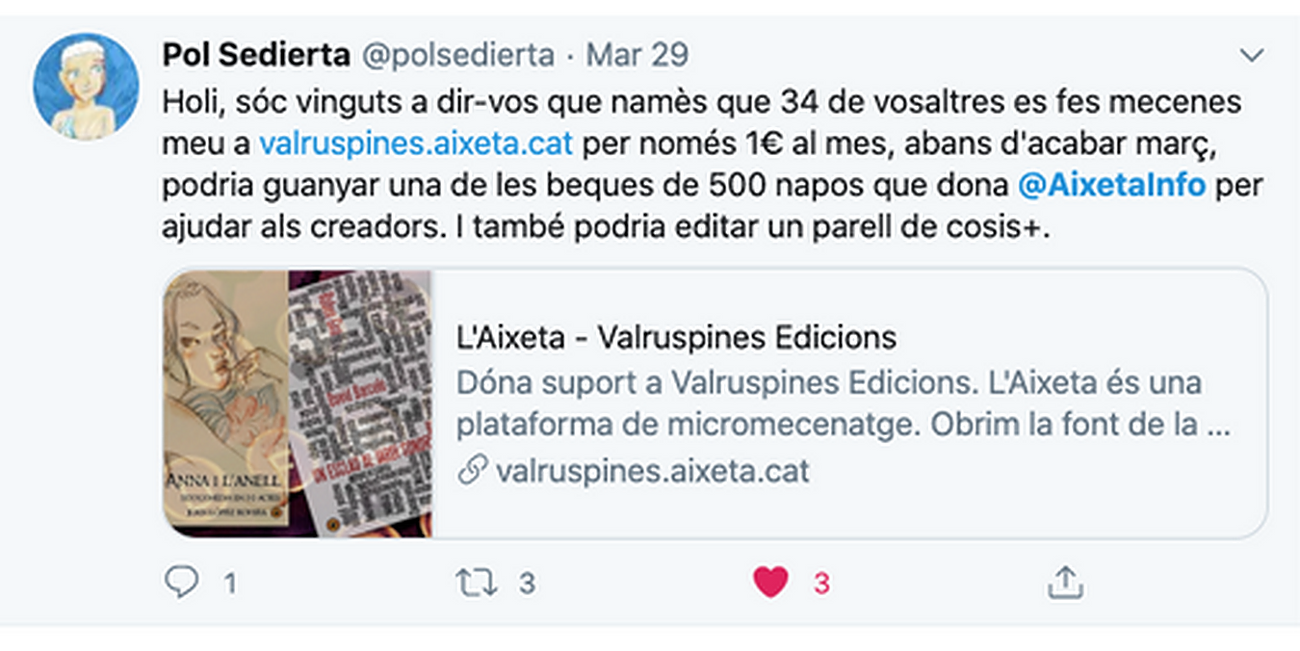
And again, a new patron responds: on the 29th itself. On March 30, Joan uploads a story and posts it on Twitter/X three times, without asking for subscriptions. And we don't think it's a coincidence that no one subscribes. Here we see the importance of asking for the action of subscribing directly. Only if you tell people what you want, and why, will you get the desired response.
Explain and ask without fear
On April 2nd and 6th, he talks directly about Aixeta again and asks for subscriptions. But it’s on the 7th that he makes a whole thread. He tells the whole story: what he writes, that he has a clear goal, that he needs people to subscribe, how subscriptions work, and he also adds some thanks.
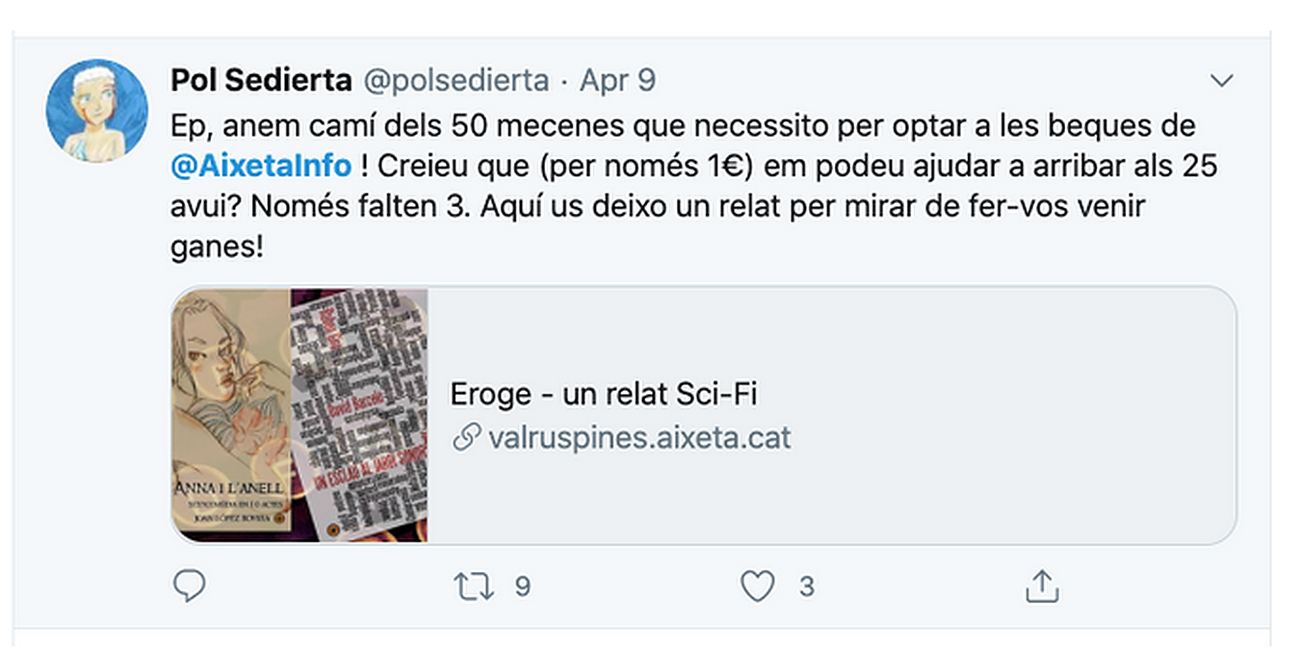
On April 8th, he returns. And he starts trying different things. He thanks the new patrons. In this sense, it is also very interesting if the new patrons publicly announce that they have become one, for the appeal effect. In his case, he puts all the content of his page open so that people can get a taste of his work. He starts making mini-goals every day —let's say we reach 25 patrons today, only 3 left— to get closer to the goal. He also combines subscription requests with new content publications.
Communication strategies that work
And now it's starting to work. On the 7th, he has a new patron, on the 8th, two more sign up. On the 9th, 10th and 11th, two more patrons each day. Between the 12th and the 16th, six more. And in the meantime, on the social network Twitter/X, he continues to tweet, every day, sometimes twice, thanking, greeting new patrons, and uploading new content. None of these things work well on their own, but combined, they are very powerful.
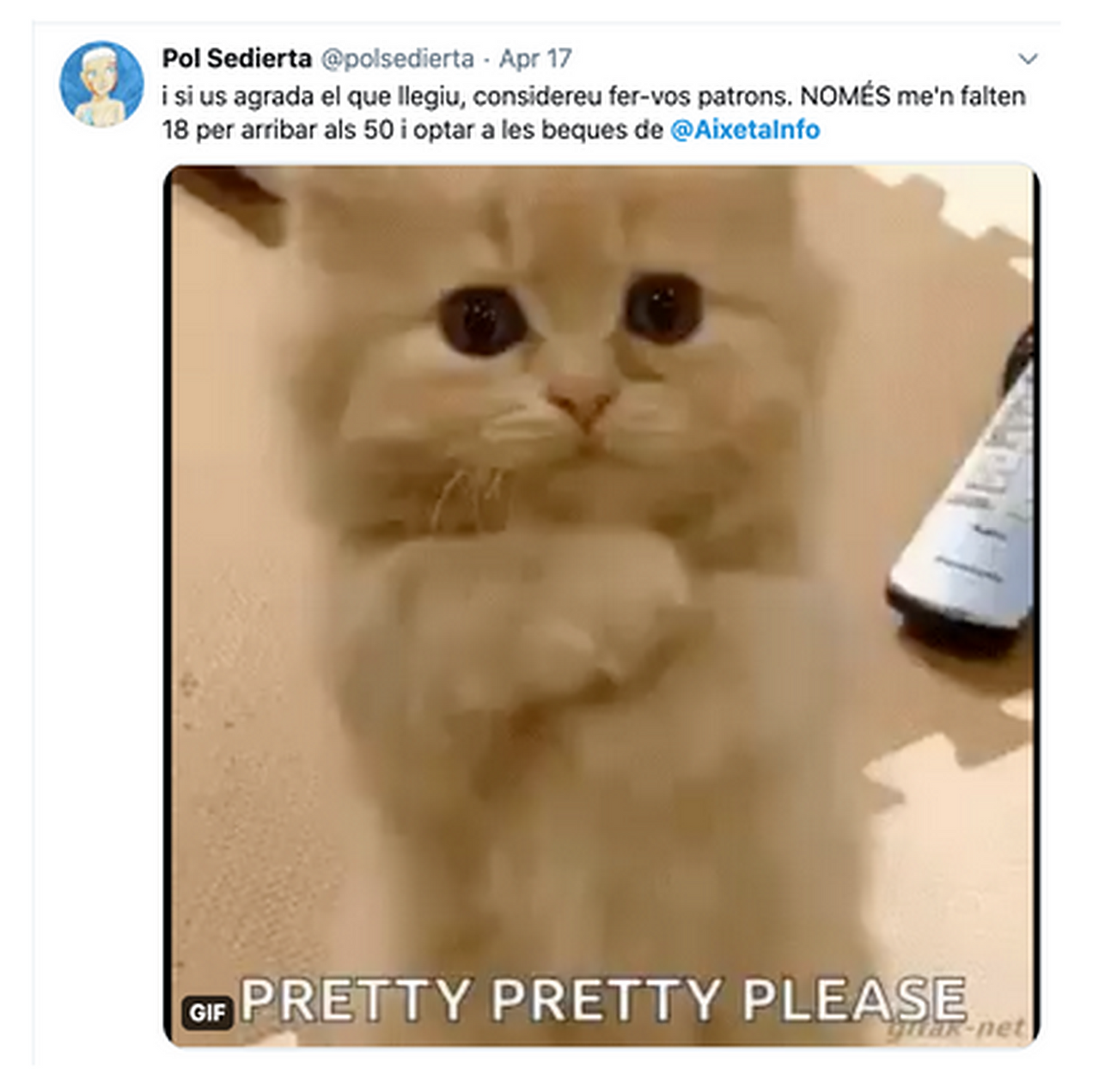
There were some days when he also posted funny tweets with animated gifs for a bit of variety:
And so on until he reached 50 patrons to be eligible for the scholarships. Which, by the way, he didn't win. But he kept the 50 patrons, with everything they give him every month, both financially and in terms of emotional support and knowing that someone is reading what he writes.
The importance of promotion
The message is very clear. You don't need to have many followers, or be very famous, you need persistent and regular promotion, positive, calling for action (#FesTeMecenes!), with clear objectives, thanks and good vibes. And if you have many followers and are well-known it will be even easier, but it is still absolutely VITAL not only to make your page known but above all to encourage your surroundings and ask people to subscribe to it. It all depends on you, on your perseverance and how you explain yourself. In fact, it is the same as what you will have had to do with a campaign on Verkami: you need to run a regular campaign and you need to ask people to subscribe to it. Be constant, original and make a call. And little by little people will sign up. Good luck and success!
Oh, and a final note. Once he reached 50 patrons, Joan stopped asking for new patrons on Twitter, and as you can imagine from what we have explained here, he has not had any new ones for the time being. (None have unsubscribed either, meaning they are all earned patrons!). With Joan's permission, we share with you the letter he wrote to his patrons once the campaign had ended.
Personal gratitude
Some of you are new to me in recent months, some of you are veterans with four years of keeping me company! But one thing is for sure, you are ALL wonderful people for having decided to accompany me and give me the necessary support to continue moving forward with this writing thing. Some with €1, some with more money but all of you are contributing what I need the most: knowing that I am not alone. Sometimes, when life doesn't leave me time for anything else, when I have to scratch out hours of sleep to be able to write a story, one of you reads it and tells me what you thought. And I've had enough, I have written something and I have connected with someone thanks to my letters.
These last couple of months have been crazy. Confined at home, asking for new patrons to be able to access the grants (which I ultimately did not win, things of chance), with the fear of going out and the fear of ending up losing the desire to go out and socialize (something that is already difficult for me in more normal times). But I didn't expect all the support I've received these weeks. Many of you who have joined the community we have at Aixeta. People retweeting and giving a helping hand to give me an "audience" and people who tell me they like the way I write (and also some who tell me they don't).
I won't deny that the fact that I have 51 patrons and that now more than €100 a month is a joy. Even if part of the money goes to taxes, the people I patronize and the rewards, there will be enough left to finance the costs of bringing out new books. Thanks to you I am self-sufficient and, if I don't earn a living writing, at least it doesn't cost me anything. And this means being able to be even more daring and thinking that by saving a little of your contributions, I will be able to buy better material and equipment to do things that are now very difficult for me to do: audiobooks, postcards, games... I will dare to write more risky things: essays, maybe I will return to poetry...
That's enough, I don't want to beat you up anymore and no, I'm not crying (YOU ARE CRYING) it's just that something has gotten into my eye.
Let me repeat once again that you are wonderful people and that I thank you with all my heart for the patience and support you give me.
Joan López Rovira (Pol Sedierta) Barcelona, June 5, 2020
Tips for attracting patrons
Lost fear of asking for help
Continuous crowdfunding is a system of collective and collaborative financing that is relatively new. Not only recently has it been present in our country, but it has really not been many years since it has arrived all over the Mediterranean and European countries. Unlike the Anglo-Saxon countries, especially the United States of America and Canada, where continuous crowdfunding is very present in creative processes and therefore enjoys a lot of popularity, in the Catalan Countries we still have to make an added effort to explain what it is, why we use it and for what purposes.
The first of the tips we want to give you is precisely to lose the fear of asking for help. It may seem like a bit of a bitch, but this attitude is essential. It is a “click” that, as creators, sometimes costs us, but it is essential for continuous crowdfunding to work. Our followers must know that we pursue economic independence, and that this, at the same time, will bring us creative independence. And, therefore, it will make possible and viable our cultural, communicative, sports proposal, etc.
We must not lose sight of the fact that, in artistic and cultural projects, we continually ask for the collaboration of the followers: we ask them to respond when selling tickets, we ask them to know what we do when we publish new material, we ask them to buy it, we ask them to follow us on that social network, we ask them to come when we make a presentation... We ask for it so many times, right? So why is it shameful to ask for your collaboration to make our project possible and sustainable, generically?
When we find the way to communicate it, and each one has his own, we realize that there are many people, more than we thought, who want to give us a hand. Come on, let's try?
Communicate the value of your work
We often feel a kind of embarrassment when we have to explain what our creative process is and how it works. But in crowdfunding and all its mechanisms, as we saw in the first council, it is very important to lose it. This has to be so because we have to get, from the outset, to establish two premises in order to create a participatory interest in our followers: openness and empathy.
Opening is essential to explain frankly and honestly not only what we do, but how we do it and for what purpose. It is essential to know how to announce the category, importance, usefulness and interest generated by our work. Always with humility, without paternalism, from honesty, but with conviction and with informative capacity. It is essential that your followers understand how you love what you do, its artistic, social, cultural dimension, etc.
Once we have established the first premise of openness, indirectly we will connect it with the second: empathy. The more details we know how to expose everything we do (especially the hours we dedicate to it, and also everything we need to achieve the expected results, whether material or intangible), the more we will emotionally approach our followers, who are also our future patrons more feasible and plausible... Let us not forget that!
With the construction of openness and empathy, which are two essential premises for the first mechanism (that of attracting patrons) of continuous crowdfunding to work, we will be able to capture the attention of those people who also appreciate and love what we do. The conclusion tells us that with openness and empathy it is easier to ask for their help, involving them and making them participate in our creative process. If they are aware that without them it is more difficult, that with them doing our work is easier, we will see how, little by little, the community of patrons is growing. Drop by drop.
Mark milestones and objectives
In the two previous tips we have already seen that continuous crowdfunding has mechanisms and operation that differentiate it from the most popular campaigns that we associate with point crowdfunding: those that pursue specific objectives, such as making possible a disc, a book, a film, etc. On the one hand we have seen that it is very important to lose the fear of asking for help and, on the other, that it is especially useful to explain the value, meaning and usefulness of our work.
As it is a slow response mechanism (sometimes it is very difficult for the first patron to arrive), we must ensure that we communicate well what we want to achieve, which is nothing less than creative self-management and the economic independence of our cultural or communicative project. We know that our followers want to collaborate and get involved in the task of making our artistic proposal possible, and our experience in continuous crowdfunding tells us that this is easier if we ask for drop-by-drop help.
What does that mean? As in point crowdfunding, continuous crowdfunding (where the support we will receive will be generic and durable) we can apply the idea of the objectives to get a better result. It will be easier to explain and, at the same time, it will also be more realistic, since we can mark more humble milestones at first, and more ambitious milestones later.
The goals can be set in two ways: with the number of patrons we want to achieve, or with the number of money we want to receive. We recommend using the first of these options, since it focuses on people, and the prominence of help lies in them. To move in this situation, it can be effective to set a deadline, which will serve to create expectation, and will generate some pressure to reach it. We will explain why we do it and, if on top of it, the rewards are exclusive, we will soon see how the patrons arrive!
Be direct, humble and sincere
We have learned that for continuous crowdfunding to work it is important to lose the fear of asking for help. In this task that we carry out as creators, we have to be very sincere in the way we communicate it, and in the construction of sincerity there is the opportunity to be direct. If we are humble, and immediately explain that we are looking for new patrons to make our project possible, our followers will immediately understand what we want and how they can participate.
Obviously, there will be a large majority of our public who will read it and will not intervene. Managing this reality is also interesting: although all our followers are our potential audience, we must bear in mind that only a small percentage will respond to our call by becoming patrons. In the next council, which we will present to you next week, we will focus on this aspect.
The fact is that if we ask for the subscription directly we will be able to arrive more quickly to these followers who are willing to become patrons of our cultural project and contribute, periodically, an economic amount. To make this possible, it is advisable to be explicit ("Become a patron!", "Subscribe!"...) and share, clearly and understandablely, in the same publication and communication, the link of your Aixeta page, more specifically in the subscription section.
You can also explain the different subscription levels that you have available, indicating, if you think it appropriate, the specific link so that followers can subscribe directly to each subscription level. Remember that in the "User Levels" section (from Aixeta creator menu) you can find the direct link for each subscription level (in the column entitled "Share").
Finally, as a formula for the success of sincerity and humility, there is gratitude. It is not absurd. It is a matter of commitment and responsibility. Thank all the new patrons! You can do it personally, but also publicly.
Manage patience
As we have seen in the zip line of advice we have shared, continuous crowdfunding has specificities that generously differentiate it from other types of crowdfunding more popular and with immediate results. This distance means that today we are dealing with one of the most complicated and emotional issues of continuous crowdfunding: the management of patience to stop frustration.
Throughout the process of attracting patrons, each creator knows what mechanism and what formula can work best. There will be those who will collect fruits through social networks, and there will be those who will do it only through the face-to-face route. In all cases, continuous crowdfunding is a proven information that results come slowly. The first patrons appear after having made a lot of diffusion, and they join in as we do not forget this essential task of promotion.
In this collective financing system, based on monthly subscriptions, it is estimated that only between 5% and 10% of our followers are our potential patrons. Those who interact more with our cultural project are considered followers. Of these, a small percentage may seem interesting to support us. That is why perseverance and perseverance are so important: above all, we will need a good organisation, a timetable, but also a discourse.
In a social and economic context so conditioned by immediacy, continuous crowdfunding requires, precisely, an exercise of patience. Here, the patrons will be achieved little by little and drop by drop, and it is normal to feel disillusionment: it is a common sensation shared by the entire creative community. It needs to be relativized, to make a good reading of the cultural proposal itself, and to re-promote a polished image.
How do payments work?
VAT and fees
1. As a creator, you should keep in mind that all contributions include VAT. In addition, they are subject to a fee from our payment gateway (Stripe), and from Aixeta itself, which we detail below. For this reason, we recommend that, in the case of subscription levels, the minimum amount is €2, so that it is credited to your account.
How are payments made?
2. When a patron subscribes to your page, or makes a one-time contribution, the amount is immediately charged through their credit card. At this point, two fees are deducted (that of Stripe and that of Aixeta), and the remaining amount is saved in a particular sub-account that we create for you in Stripe. At the end of the month, we take all the money that you have accumulated throughout the month and make a detailed written statement (the settlement), issue an invoice for the two fees, and make a bank transfer to your account. Stripe charges an additional payment fee.
Aixeta Fee
3. In the case of subscriptions, Aixeta charges a 5% fee on all payments. In the case of contributions to specific campaigns, Aixeta charges a fee of only 2.5%.
Stripe Fee
4. In all cases, Stripe keeps a fee when collecting each sponsorship. There are two possible formulas. In each, there is a fixed part and a part that is a percentage of the total amount of the contribution:
If the sponsorship is equal to or less than €5, Stripe charges a commission of 5% + €0.05
If the sponsorship is greater than €5, Stripe charges a commission of 1.4% + €0.25 (or 2.9% + €0.25 if the card belongs to a current account outside Spain)
The difference in commissions has been negotiated from Aixeta directly with Stripe to reduce as much as possible what you as a creator have to pay to the payment gateway, with a very small fixed amount for small subscriptions, and a very low percentage for larger subscriptions.
Stripe also charges a commission when making the settlement, explained in point 6, below.
When are subscriptions charged?
5. Subscriptions are charged automatically when the subscription is started and, after that, they renew every month on the same day of the month as the original sign-up date. If a month does not have that day, the charge is made on the last day of that month. Subscriptions that were already renewing on the 1st, according to the system in place before June 2026, will continue to renew on the 1st. Contributions to one-off campaigns are charged at the moment they are made.
When do I receive the money?
6. On the 10th of each month, if you have accumulated at least €25, Aixeta issues a transfer order to your bank account. This payout includes the income accumulated since the last payout: new subscriptions, one-off contributions, and subscription renewals charged during that period.
Stripe deducts €2.10 + 0.25% of the total amount transferred, as a bank transfer fee.
For example, if you have accumulated €1,000 over the course of the month, Stripe charges €4.60 (1,000*0.25%=€2.50 + €2.10) and a transfer of the remaining €995.40 is made to your bank account.
The transfer may take a few days to take effect and reach your bank account. It usually does so between the 12th and 14th of each month.
Aixeta Invoice
7. Aixeta sends you an invoice for the last period for both Aixeta and Stripe fees, applying 21% VAT. You can also consult and download the rest from the Invoices page.
Collections list
8. You can generate a list of amounts collected from patrons to invoice them or calculate the VAT settlement on the Charges page (you access it by choosing Income in the menu that opens from the round icon, and then clicking on Charges, in the list on the left).
Next settlement
9. The Next payout page adds up the income accumulated since the last payout to give you an idea of what the amount of the next payout will be. It shows new subscriptions, one-off contributions, and subscription renewals as they are charged during the period.
Check settlements and invoices
10. You can check and download payouts and invoices in the corresponding sections of the Income section.
How do one-off campaigns work?
One-off campaigns allow you to receive financial support from your followers and patrons to make a specific project possible. It is a tool that comes from classic micro-crowdfunding, and that Aixeta has recently implemented, so that creators like you can receive funding to make extraordinary projects a reality, beyond the usual activity of your cultural, artistic, communicative or sporting proposal.
Features
Contributions received in one-off campaigns are collected only once, and can help make a specific goal possible (a book, an album, a video, a short film, a game, a study, a documentary, etc.).
Unlike specific crowdfunding platforms, on Aixeta there is no time limit when it comes to achieving the economic horizon that is pursued.
On Aixeta, it is each creator who decides the economic goal, the start date, and also the end date.
Aixeta's one-off campaigns are open, that is, each contributor (patron) makes the contribution with the economic amount that suits them best.
Consequently, in Aixeta's one-off campaigns there is only one contribution method: each contributor decides the money they want to contribute.
Commissions
For one-off campaigns, Aixeta charges a commission of only 2.5% for each contribution.
Stripe (the payment processor) also keeps a commission when collecting each contribution. There are two possible formulas, with a fixed part and a part that is a percentage of the total amount of the contribution:
→ If the contribution is equal to or less than €5, Stripe charges a commission of 5% + €0.05. → If the contribution is greater than €5, Stripe charges a commission of 1.4% + €0.25 (or 2.9% + €0.25 if the card belongs to a current account outside Spain).
How do I create and edit a one-off campaign?
To create a one-off campaign, go to the One-off Campaigns section. Once inside, click on the "Add" button. The screen will open with the one-off campaign that you will edit and configure from scratch:
Name: choose a name for your one-off campaign.
Goal: choose the financial amount you want to reach.
Activate: if you select "yes", it will allow you to have the one-off campaign live and start receiving contributions. The Campaigns tab will automatically appear on your Aixeta page, which will contain the one-off campaign you just created.
Featured: if you select "yes", the one-off campaign will be displayed on the front page of your Aixeta page.
Description: write a brief description so that your followers and patrons can understand the reasons and/or objectives when making their contribution. The first paragraph will be displayed on the main page if you highlight this one-off campaign.
Image: Upload an image with a maximum size of 3MB to display as the image of the one-off campaign. If you do not upload an image, Aixeta will use a default image.
Thank you message: Write the thank you message for users who contribute to this one-off campaign. They will automatically receive it in Aixeta's internal message box, and you can also use it to request extra information in the event that the contribution they just made requires a reward to be sent.
Edition of a one-off campaign (1/2)
Edition of a one-off campaign (2/2)
How do I monitor the progress of the one-off campaign?
You can track your one-off campaign from all these spaces:
From the One-off Campaigns section itself, where you can see the amount raised (contributed column), the number of people who have collaborated so far (contributions column), and where you will also find the link to share the one-off campaign on social networks.
One-off Campaigns Section
From the Campaigns tab of your Aixeta page, where you will see the one-off campaign you have active, and you will be able to check the contributions received, the percentage achieved in relation to the goal, the accumulated financial amount, as well as the information (name, description and image) entered when creating the one-off campaign.
"Campaigns" tab on the creator page
From the front page of your Aixeta page, if you have decided to highlight the campaign, you will also be able to track it (you will find it above, in point number 4 of How do I create and edit one-off campaign?). There you will see, in a more reduced and schematic form, the same information that we explained previously.
Featured campaign on front page
How can I do this if I want to offer rewards?
Since the one-off campaigns of the Aixeta only have one contribution method (open, where each contributor decides the financial amount they want to contribute), you may find it strange to consider the option of offering rewards in exchange for contributions. But don't worry, because below we propose some possibilities:
Expose it in the description
Be clear in the description of the one-off campaign, and specify that all those people who make a contribution equal to or greater than a specific amount of money will receive, in return, a reward. Later, by accessing the contributors' data, you will be able to see what contributions have been made, and contact those people who have contributed with the economic amount corresponding to that of the reward.
Offers various rewards
Following the above logic, you can determine different rewards, in relation to different economic amounts, and specify it clearly and simply in the description of the one-off campaign. For example:
With a contribution of €10: you will receive a unique signed postcard!
With a contribution of €20: you will receive the signed book + a unique signed postcard!
With a contribution of €50: you will receive two signed books + two unique signed postcards
Condition it to the goal
Explain in the description of your one-off campaign that once the goal is reached, everyone who has contributed will receive a reward in return. It may not have to be a physical reward. You can collect the data of all contributors once you have finished the campaign, and send an email to all of them with a surprise, an image, a video, an audio... in short, a detail.
How can I get information about contributors?
In the One-off Campaigns section, when you have campaigns created, on the right side of each one you will see a button that says "Options". When you click on it, a small menu will open, with the following options:
Contributors
Edit
Delete
One-off campaigns section
Options
If you click on the first option (Contributors), a screen will open where you can see all the people who have collaborated with your one-off campaign. The table that appears shows the following information:
Name of the person who has contributed to the one-off campaign.
Date of contribution.
Information regarding whether the contributor follows you on Aixeta.
Information regarding whether the contributor is your patron on Aixeta.
Amount of money contributed.
Contact details: in this column we specify whether you have requested contact details in case you have to send a reward. There are two possible answers: Requested / Not requested.
Message: to contact the contributor directly.
Information about a one-off campaign
At the top of this table with all the contributors to the one-off campaign, you will see 4 buttons:
Clean: used to clean up previous information searches.
Search: used to search for information in the context of the table shown.
Contact details: used to request the contact details of the contributors in bulk (email, address and telephone), in order to have them at hand in case your one-off campaign requires rewards deliveries.
Calc/Excel: used to receive the information that appears in the table, plus the contact details of the contributors, in your email. If you need to have the names of the contributors in order to be able to thank them for their help by citing them, to control the amounts contributed, to prepare the shipments of the rewards, etc., this button will be very useful. When you click on it, after a few seconds you will receive a compressed file (in *.zip format) that will contain a spreadsheet (in *.xls or *.xlsx format) in your email, which will bring together all the contributors' data.
Can I have more than one-off campaign created and active?
Yes, that's right! You can create and activate as many one-off campaigns as you want. You can control them from the One-off Campaigns section, and they will be sorted in the Campaigns tab (on your Aixeta page) by creation date.
How to manage non-payments from patrons?
What are non-payments and why do they occur?
Non-payments are contributions from your patrons that, for various reasons, have not been able to be made and, consequently, remain pending and are recorded as collections that have not been processed. In general terms, in the micro-fundraising ecosystem, and also in the Aixeta ecosystem, non-payments can represent between 5% and 15% of total contributions. Below we detail the most common reasons and causes that may be behind a problem of this nature:
There are not enough funds in the current account associated with the card
The card has exceeded its credit limit (maximum monthly amount that can be spent)
The credit or debit card has expired
Change of credit or debit card (loss, theft, etc.)
The payment method data is incorrect
The patron's financial institution has blocked the financial transaction
The financial institution has revoked the authorization of the recurring payment
There are authorization and authentication problems in relation to the recurring payment and the financial institution
How does Aixeta manage non-payments?
When our system detects a problem with a payment, we automatically send an email to the corresponding patron, informing them of the incident with as much detail as possible, according to the data provided by our payment processor (Stripe). This email details the reason for the non-payment, and the user is given a direct link to resolve it, in the event that the problem has to do with the expiration of the debit or credit card, lack of funds or errors in the payment method data. In the event that there are problems related to authorizations, authentications and blocks by the financial institution, the user is also informed, recommending that they contact their bank or cashier, in order to resolve it. When we send this first email, our system automatically generates a retry of collection after 3 days. If this retry is unsuccessful, we send the user another email, specifying, again, that the subscription could not be charged, and detailing the reason again. If the retry of the charge fails, our system waits until the next month to try again, in order not to overwhelm the user with emails or insist excessively.
In summary, if a patron's payment is not made correctly, Aixeta does the following:
Send an email to the user notifying them of the default and the reason
Process the payment again after 3 days
If this retry fails, an email is sent to them again
Stricter methods that Aixeta is considering implementing for patrons with a current default:
Inform the patron of the default via an ad bar in the Aixeta user account infrastructure
Restrict access to the content of the creator they support while the default is in effect
View your patrons' unpaid contributions
Creators can check the status of the members of your patron community in the Community section. Within this section, you will find three subsections: Patrons, Followers, and Creators. If you click on the first one, you will enter a space where you can see all of your patrons.
In the By status column, select the Active (with unpaid) option and then click on the Search button
For each user that appears in this list, click on See more to check if the non-payment is current or corresponds to a past moment
If you confirm that the non-payment is current, send a message to the patron, using the Write a message button, to inform them of the situation
You can also check the status of payments and collections in the Income and Charges section. Here, in the Status column, you can select the type of non-payment, and see the corresponding patrons.
Types of non-payment
Failed: corresponds to lost, deactivated or expired cards, incorrect payment method data, cards with exceeded credit limit, and lack of funds in the current account. Action required: corresponds to problems that the user must resolve with their management, authorizing the payment through their financial institution's mobile application, or through the customer area of the bank or cashier's website. It is also possible that the financial institution has denied and blocked the payment, and the user must contact their office to reauthorize it. Pending: payment request efected correctly, but not yet finalized or executed. This is usually due to a problem with the financial institution, which must finish authorizing the financial transaction. The user needs to communicate this to their bank branch.
How can non-payments be avoided?
Although Aixeta sends emails and automatic notifications every time we detect a non-payment, we have seen that individualized messages written by the creator can be the best method to avoid and resolve them. In order to reduce the number of non-made payments, from Aixeta we recommend that you send personal messages to your patrons who have outstanding non-payments, informing them of the problem and the possibility of resolving it. You can see a list of active patrons who accumulate non-payments by going to the Community section and, subsequently, to the Patrons subsection. Once you are there, use the following search tools: in the selector titled "By status", choose the Active (with unpaid) option. Then, press the "Search" button, and you will see a list of active patrons who have any unpaid balances. For each of them, click on See more; this way you will be able to see if the unpaid balance is current (current) or old (resolved). You can contact these patrons directly using the Messaging option. You can write them a message, which they will receive in their internal Aixeta mailbox, but also in their email inbox. To make this task easier for you, in these messages you can attach or link to the Help Guide for resolving failed payments (available in the Material for creators section), information that we make available to patrons so that they can resolve the causes of their unpaid balances. We hope it is of interest to you, and that it can help reduce non-payments by your patrons!
Help guide to resolving failed payments
Introduction
Dear Aixeta user: this is a guide that will help you resolve some problems related to non-payments. Often, without being aware of it, we stop providing financial support to those cultural and communication projects that, one day, we decided that we wanted to support. There are many different reasons that cause these non-payments, and here we will try to help you, if you think it is appropriate, to resolve it and provide a solution.
Have you received an email informing you of a problem with the payment of your subscription?
In the event that Aixeta has not been able to collect your subscription from the creator or project you support, our platform sends you an email to your inbox. This email is sent automatically when our system detects an error in processing the payment. In the message we send you, we explain that it has been impossible to make the financial contribution, and we detail the reason that generated the error. As a general rule, the most common causes of failed payments are the following:
There are not enough funds in the current account associated with the card
The card has exceeded its credit limit (maximum monthly amount that can be spent)
The credit or debit card has expired
You have changed your credit or debit card (loss, theft, etc.)
The payment method details are incorrect
The financial institution has blocked the financial transaction
The financial institution has revoked the authorisation of the recurring payment
There are authorisation and authentication problems in relation to the recurring payment and the financial institution
In the email we send you, we also attach a link so that you can update the payment method details (in the case of expiry dates, or incorrect card details), or we inform you that there is a pending request that requires your management in order to authorise and authenticate the transaction (through the mobile application, or the customer area of the website, of the financial institution). L'Aixeta will try to collect again after 3 days. If this retry is unsuccessful, it will try again next month.
What do I do if I don't have enough money?
If the problem causing your non-payment is a lack of funds in your checking account... don't worry! The creators and the creative community of this country know what it's all about. We recommend that you contact the creator or project you are supporting, and send them a message in order to inform them of this situation, with complete sincerity. The creator or project will understand perfectly, and when you have more financial solvency you will be able to make the subscription payment normally again.
You can send a message to the creator or project you are supporting from the Supporting section of your user menu. Once inside, click on the box of the corresponding creator or project. You will see your subscription level and, on the right, a menu with three buttons. The first one says Send them a message. Click on it and you will be able to send them a message that the creator or project will receive both in their internal Aixeta messaging and in their personal email.
Make sure the payment method is valid
One of the most common errors that has a direct relationship with non-payments is the expiration date of your debit or credit card. Another failure in this regard is having changed cards (due to loss or theft), and not having updated it in your user space on the Aixeta platform. We recommend that you review it and, if necessary, re-enter a valid payment method.
From Aixeta, we recommend that you always do this process from a computer. On mobile devices, there are problems with overlapping information caused by browser tabs, authentication and authorization requirements from financial institutions, validations that must be made with mobile applications from banks and savings banks, and information that must be sent back to the Aixeta platform. By doing it from a computer, all these problems with overlapping information disappear.
You can enter the payment method in the Payment method section of your menu as a user. For now, only credit or debit cards can be entered. You must provide your card number, its expiration date and the three control numbers. Once you have entered this data, you can click on the Save button. At this point, the Aixeta system will automatically contact your bank to request authorization and, in this way, be able to enable the payment method. You will have to do this authentication through the mobile application that has ability at your bank, or from the personal space that the financial institution reserves for you as a client on its website. You will see that our system makes a request to your bank with an economic amount of €0.00. This is normal, don't worry: it is only the mechanism that we use to link your credit or debit card with our payment gateway. Once you have completed this authorization, your card will appear as a new payment method. You can delete, replace and update it whenever you want.
How do I manage the required action that the financial institution asks me to take?
There are three cases in which your bank or savings bank asks you to intervene in some way to be able to make the payment, making a request that, in most cases, you can resolve by accessing your bank's or savings bank's mobile application, or from the financial institution's client space that you will find on its website.
The cases that can be resolved with this new authorization procedure are presented when:
The financial institution has revoked the authorization of the recurring payment
There are authorization and authentication problems in relation to the recurring payment and the financial institution
When we bring up the concept of Required Action, we always refer to a request that the financial institution makes to its client, in order to give continuity to the movement. There are constantly new regulations from the European Union that oblige banks and savings banks to establish new layers of security to prevent fraud and scams. Although, in the case of subscriptions, it has been a while since the financial transaction was authorized and validated, many financial institutions now ask for these authentications again from time to time. This means that, in most cases, patrons must authorize the movement in the application for mobile devices or in the client website of their bank or savings bank.
There is one last case that requires you to contact your bank branch, and that is when:
The financial institution has blocked the financial transaction
In these circumstances, there is a stoppage of the collection by the bank, for different reasons that the financial institution does not specify to us, and that is not specified to our payment processor (Stripe). On this occasion, when there is no authorization and authentication requirement that can be resolved through the mobile application or from the customer space on the bank or cashier's website, what is most useful is that you, as a customer (of the financial institution), and as a patron (of the creator or project you support), contact your bank branch, or directly with the manager assigned to you, to be able to comment on it and resolve it.
As we explained previously, Aixeta always automatically sends patrons an email every time we attempt a collection and there is an error. We will notify you of the error and the possible solution. But if you, as a user of our platform, follow up on it, it will be more effective.
I have already solved the problem: can I try the payment again?
Yes, that's right! It's very simple! Below, we will explain all the steps:
If there is any payment that appears marked with an Action required, you must authorize the economic movement as specified in the section "How do I manage the required action requested by the financial institution?"
If there is a failed payment, highlighted in red, next to it you will find a link that says Retry
Click on this link, and you will see that the page refreshes, indicating that the payment is being processed again
Wait between 5 and 10 seconds, and refresh the page manually, pressing the F5 key on your keyboard (if you do it from a computer)
If the payment has been made correctly, in the Status column, the movement will appear marked as Paid and highlighted in green
If the payment appears again as failed, you must review all the steps that we specify in the section "Make sure that the payment method is valid"
If none of this works, what can I do?
If you have followed all our recommendations point by point and you are unable to solve the problem, we have one last solution, like a kind of lifesaver.
Go to the Supportingsection in your management panel
Look at the row corresponding to Subscriptions.
Click on the creator with whom you are having a payment problem
Once inside, look for the red button, where it says Unsubscribe
With this action, you will cancel the subscription with the creator, and now you will have to start it again
Go to our Exploresection, and use the explore panel to search for your creator's page
Once you have found it, go to their subscriptions section, choose the subscription level that interests you most and press the Subscribe button!
You will start the subscription process again as you did at the time, and this way you can update the permissions and authorizations between the recurring payment of the Tap and your financial institution.
Finance and taxation
Initial recommendation from Aixeta
Both in the area of tax obligations and social security, we advise you to consult your advisor or your agency, where they will analyze the cases individually and particularly, with all the nuances and taking into account your reality, and they will indicate the best way to proceed.
How to declare income generated by crowdfunding?
There are several questions that, from a tax and social security contribution point of view, arise when receiving financial amounts through crowdfunding. In the tax area, the general rule would be that donations and contributions received in this framework are not subject to VAT. This means that the amounts received thanks to patrons as donations will not generate a VAT debt that must be paid to the Tax Agency.
It should be noted, however, that this rule may change if, in reality, you are providing some good or service in exchange for the donation. If the donation is linked to a specific consideration (such as a product, service or advantage), it could be subject to VAT. If the donation has no counterpart, that is, there is no physical or concrete reward in return, and is understood as generic support, it is subject only to Donation Tax. At this point, we can distinguish two situations:
First. When the amounts received do not have any consideration from the creator, they are considered a donation and should be taxed by Donation Tax.
Second. When the amounts are received in return for some delivery of goods or provision of services, the operation would be onerous in nature, and in this case VAT or the corresponding tax must be paid.
However, in the cases of this second situation, it is necessary to observe whether there is equivalence in the consideration. In this type of operation, a series of rewards are usually granted to patrons, whether it is the delivery of goods (alcs, books, t-shirts, illustrations, DVDs, etc.) or of another more intangible type (video or music downloads, access to content, attendance at an event, etc.) that would not correspond to the value of the contribution, that is, there is no equivalence between the contribution and the reward. In this circumstance, it would be necessary to adjust the amount to be declared, since a difference in economic amounts becomes evident between the figure contributed by the patron and the value of what is delivered as a reward by the creator.
In conclusion, it would be necessary to tax in the manner determined by the consultation with the Tax Agency that we link below, and which basically means that, with respect to the part of the contribution on which there is no consideration and, therefore, it is a donation, it must be taxed by Donation Tax. And for the part that corresponds to the reward, it must be taxed by VAT or the corresponding tax.
Is it necessary to register with Social Security?
In the field of social security, we often wonder whether it is mandatory to register as self-employed (RETA). Social security considers "self-employed" to be someone who habitually, personally and directly carries out an economic activity. An indicator of habit can be the fact of exceeding a certain level of income (in this case the SMI, Interprofessional Minimum Wage). But having lower incomes does not exclude us from being considered self-employed, with the consequent obligation to contribute to the Special Self-Employed Workers' Regime.
We could say that if the activity is sporadic and does not generate income above the SMI, it would not be necessary to register as self-employed. On the other hand, if there is regularity and regularity, even if the income does not exceed the SMI amount, social security could require registration in the self-employed regime. In any case, there are many nuances and each case must be assessed individually. Currently (January 2026), the SMI in the Spanish State is €1,184.
It should be remembered, at least, that the formal obligations with the Treasury are independent of the obligation or not to register as self-employed. And also, and no less importantly, there is the possibility of registering and deregistering as a freelancer up to 3 times a year, paying only for the days contributed.
Donations
If your project uses Aixeta to receive generic financial support, without offering specific rewards, you can take advantage of this modality. The Donation Tax rule states that it must be paid within 30 days of the donation. For practical purposes, in the case of the creators of Aixeta, it is a very strict rule, because making a monthly payment for €20, €50 or €100 can be a hassle and, in addition, has a management cost (in the event that it is done through a consultancy or management agency). If there is no contract or document that establishes otherwise, it is a generosity that the patron makes monthly (and that he can stop doing whenever you want) and it is difficult to declare and make it in any other way.
What is Donation Tax?
According to the Tax Agency of Catalonia (ATC), a donation is an act of generosity, during the lifetime, by which the donor provides something or a right free of charge to the donee, who acquires it when he accepts it. The tax that regulates its activity is the Donation Tax, and it is, as with other taxes, an amount of money required by public administrations from each citizen (or company) as a contribution to public spending, according to their activities and economic results. In the case of donations made through Aixeta, the tax is 14%. Therefore, for every €100 received, €14 should be paid.
The ATC has a very intuitive and useful guide where it explains various aspects related to donations and their tax: Practical guide to inheritance and donation tax. On page 44 (point II.B) you will find the reference to donations.
How to make the monthly payment of the Donation Tax?
According to the tax regulations, each donation should be taxed individually each time it occurs and, in addition, the donor's details (name, surname and NIF) should be indicated. Since this is not feasible, a possible solution for those who want to declare the tax on the money received would be to make a monthly declaration. Since we do not have the donors' details and, moreover, it would not make sense to make a declaration for each of them, what we recommend is to make a monthly declaration with the total amount received and, in place of the donor's details, indicate the name and NIF of Aixeta (Associació l'Aixeta de promoció cultural - G67322925). Despite not being formally correct, the Tax Agency of Catalonia would accept it. In this sense, we have consulted Tributs de la Generalitat and they have replied that the tax could be settled by putting as the donor's details, those of the platform that manages it, in this case l'Aixeta, although it is clear that l'Aixeta only acts as an intermediary and is in no case the donor.
The literal response of the Generalitat Tax Office to the case raised was: In the event that the taxable person is a natural person, you can indicate as the donor the NIF and the data of the platform on which the crowdfunding is being managed, declaring the total received during the month if this does not exceed the first tranche of the rate.
Can you make the settlement for the Donation Tax only once a year?
Despite not being formally correct, since the tax regulations require the declaration to be made within one month of the fact, we think that there would be no problem doing it this way. In Aixeta there is a specific record (at the level of documentation) of this recurring donation, and we could make the annual settlement of the money received, because there are documents, and therefore records, where the donations are registered, despite the fact that these are made monthly. For practical purposes, for a creator who receives X€ a year, if he makes an annual settlement and pays the corresponding donation tax, common sense tells us that he would be acting correctly, although it is not exactly what the law establishes. There are as many interpretations as interpreters, and that is why we recommend that your agency guide you through this entire process.
Practical examples
Simple article to understand the taxation of crowdfunding: click here
Binding and official consultation, with a response from the Tax Agency itself: click here
Accompaniment to musical projects
Do you have a musical project? We're here for you!
Do you have a musical project and would you like to receive monthly financial support from your followers, as well as create a community with them? Don't know where to start with your page on Aixeta, don't have time to think or publish content, or promote it on social networks? Do you think you won't get much out of it or do you simply feel uncomfortable asking your followers to subscribe? We're here for you!
First, it's important to be clear that you have a lot to offer, and that there's no need to create new content. You can think of content that you're discarding, but may be of interest, discounts or preference when purchasing tickets, merchandising, access to rehearsals or backstage, personal material such as scores or instructional videos, a telegram channel for subscribers where you can spread or send some personal photos during the tour or the creation of a music video... You can find reward ideas for music projects in the "Reward Guide" section of Creator Stuff.
Ideas for promoting the first month
The campaign will have the same aesthetic line, this means that the publications will follow the same typography, colors and appearance. This is a proposed calendar for the first 5 weeks, which should be adapted to the contents:
Let's give examples
It is interesting to make use of everything that the networks offer us and that does not require much effort:
Upload stories and create a prominent “Aixeta” so that they are saved
During the campaign, leave the campaign start tweet with the link to the page, pinned
Upload short, easy and personal videos, in stories or in tweets/posts.
Promote the community, interact: draw, surveys, hashtags, ask questions...
Tag us at @aixetacat so that we can retweet, repost, comment...!
Incorporate the link to Aixeta page in your Twitter, Instagram profiles... and put it in your tweets, stories...
It is also useful to explain how Aixeta works, why you find crowdfunding interesting... You can explain it in the initial thread/post.
Ask them directly to subscribe! Explain why and thank them.
Set a goal for the first month of promotion (goal of X new patrons). It is important to have a goal for this first month of promotion, and share with your social media followers how many patrons you have achieved so far. It can be a simple “countdown” or promote a small “prize” for the first X patrons… At any time, a publication will be made when this number of patrons is reached, thanking them for their support.
Let's put images in it
Here are some basic design ideas to promote reward levels (inspired by the levels currently proposed by Pau Alabajos on his Aixeta page), the raffle, to say thank you in stories, etc.
A collection of rewards you can offer to your support community. Obviously, you don't have to offer them all, but perhaps this document can help you think about what you can/want to offer your followers to encourage them to subscribe to your pages. All of these rewards also serve as promotional tools in a way.
Music
Access to different formats of published songs
Previews of songs that will be published soon
Ask for feedback from subscribers
Songs not yet published
Lyrics with designs and printables (can incorporate photos, illustrations, etc.)
Song scores (or in pdf to download, or printed, possibly signed)
Easier versions of songs to sing at home
Anecdotes, origins of songs
Score book
Concerts
Free or discounted tickets
Be able to buy tickets before anyone else
Exclusive seats
Attend sound checks
Access to the backstage and be able to greet the artists
Be able to vote on the repertoire
Be able to make song requests
Access to videos and photos of the backstage
Exclusive concerts for subscribers
Exclusive content
Previews of information for subscribers: concerts, breaks, new songs, new video clips, personal information (birthdays, for example)
Monthly newsletter with information about music (about the group or other interesting topics)
Personalized birthday greeting messages
Music workshop or class (teaching a song of your own or maybe teaching how to play/sing, etc. in general)
Audiovisual content
Photos behind the scenes, before or during a concert…
Old, personal photos…
Photos from the making of videos
Signed, printed, dedicated, personalized photos…
Podcast episodes explaining the history of the songs, anecdotes, curiosities…
Special version of a video clip only for subscribers (longer, with extra scenes, with making of…)
Videos or photos of rehearsals, personal things…
Videos of creative sessions, writing lyrics or music, song construction process, concerts, preparing for a concert or after a concert…
Video of a song dedicated to someone (to a subscriber or whoever they want)
Personal contact
Virtual meetings, questions and answers, interviews of the different members of the group…
Face-to-face meetings (dinner, lunch, having a beer, coffee, etc.), a meeting of a larger or smaller group, or individual…
Access to a rehearsal, backstage…
Exclusive Whatsapp or Telegram group for subscribers
Listen to a musical proposal from the subscriber and give feedback
Merchandise
T-shirts, sweatshirts, bags, badges, mugs, etc.
Surprise items
Exclusive merchandise only for subscribers
Let subscribers vote on different designs
Special raffles for subscribers
Photo album from a tour, past or present
Recognition and gratitude
Include the names of subscribers as a thank you in a video clip, website, album cover or booklet…
Thank a subscriber by mentioning them on Instagram, Twitter, Facebook, Mastodon…
Access to promotions and discounts from other projects/stores
Sending a postcard during the holidays
Live or video birthday greeting
Activism, community and popular culture
Reward ideas for activism, community and popular culture projects ( go to index)
A collection of rewards you can offer to your support community. Obviously, you don't have to offer them all, but maybe this document can help you think about what is you can/want to offer your followers to encourage them to become subscribers of your pages. All these rewards also serve in a way as promotional tools.
Content
Subscription to a weekly/monthly newsletter with exclusive information
Exclusive photos or videos for subscribers of project activities
Participation
Surveys to decide on the next workshops or activities
Surveys or online meetings to decide on the next actions or campaigns
Votes to choose songs to play at the parties
Participate in workshops, classes… exclusive to subscribers
Participation in a solidarity donation for a specific project
Merchandising
T-shirts, sweatshirts, bags, badges, cups, etc.
Surprise items
Exclusive merchandise only for subscribers
Let subscribers vote on different designs
Special raffles for subscribers
Thank you and personal contact
Exclusive Whatsapp or Telegram group for subscribers
Possibility to participate in events and parties exclusive to subscribers
Discounts on bar service and food (in the space, at organized events...)
Thank a subscriber by mentioning them on Instagram, Twitter, Facebook, Mastodon...
Invitation to a coffee, tea, beer...
Access to promotions and discounts from other projects
Circus, theater and shows
Reward ideas for circus, theater and shows ( go to index)
Collection of rewards you can offer your support community. Obviously, you don't have to offer them all, but maybe this document can help you think about what you can/want to offer your followers to encourage them to subscribe to your pages. All of these rewards also serve as promotional tools in some way.
Shows
Free or discounted tickets
Be able to buy tickets before anyone else
Exclusive seats
Attend rehearsals
Access to the backstage
Exclusive meetings with the artists
Access to backstage videos and photos
Appear as a collaborator in a show
Rehearsals
Access to rehearsals, tests or dress rehearsals
Masterclass to learn skills (juggling, creative process, balance beam, clowning...)
Specific group workshops
Exclusive content
First information for subscribers: shows, breaks, improvements, personal information (birthdays, for example)
Monthly newsletter with information about the company's field or other interesting professional and cultural aspects
Personalized birthday greeting messages
Audiovisual content
Photos behind the scenes, before or during the show...
Collection of rewards that you can offer to your support community. Obviously, you don't have to offer them all, but perhaps this document can help you think about what you can/want to offer your followers to encourage them to become subscribers to your pages. All of these rewards also serve in a way as promotional tools.
Contents
Early access to published videos (1 or 2 days before; or even a week)
Access to an exclusive Whatsapp or Telegram channel for subscribers where you can propose topics for upcoming videos, ideas, etc.
Access to podcasts, illustrations, photographs, writings or other extra content that the creator also works on
Exclusive content
First-hand information for subscribers: upcoming projects, raffles, collaborations, personal information (birthdays, for example)
Recommendations for external content (music, movies, shows, apps, games, material from other creators, etc.) as a monthly publication
Access to private Twitch live streams
Personalized birthday greeting messages
Workshops on creator skills, how to create content, how to deal with themes, etc.
Sharing (on social networks) the publications of a collaborator or patron
Personal contact
Virtual meetings, with questions and answers
Face-to-face meetings (dinner, lunch, having a beer, coffee, etc.)
Recognition and gratitude
Include the names of subscribers as a thank you in YouTube videos, Twitch, Tik-Tok…
Thank a subscriber by mentioning them on Instagram, Twitter, Facebook, Mastodon…
Appear in a video with the creator
Access to promotions and discounts from other projects/stores
Birthday greetings live or by video
Publishing, magazines and literature
Rewards for publishing houses, magazines and writers ( go to index)
Collection of rewards that you can offer to your support community. Obviously, you don't have to offer them all, but perhaps this document can help you think about what you can/want to offer your followers to encourage them to become subscribers to your pages. All these rewards also serve in a way as promotional tools.
Content
Access to publications before they are published
Access to extra content every so often (news dossier, special monograph, etc.)
Access to unpublished texts (not yet published or discarded)
Subscription to a weekly/monthly newsletter with exclusive information
Access to a workshop (for example, bibliography, how to organize a library, archives, an online or in-person book club, how to organize a publishing house, the creative process of an author, etc.)
Personalized alerts (of own or external content)
Access to a blog with special content
Access to (old) back-end books
Special articles: recommendations for Sant Jordi, for summer, for Christmas, etc.
List of bestsellers, collections of most read articles, etc.
Define subscription levels according to the number of books, magazines, articles, editions, etc. that the patron will receive per month/quarter/year.
Being able to receive books and other shipments at home
Being able to choose a local bookstore that also benefits from the subscription (and being able to pick up the purchase at that bookstore, if desired)
Participation
Surveys to decide on the next topics of the articles
Participation with opinion articles in the magazine
Participation in a solidarity donation to a specific project
Participation in a publication draw
Participation in events in bookstores, libraries, schools, institutes...
Participation in book signings or publication presentations
Participation in writing awards (literary, essay...) exclusive to subscribers
Reading of texts from subscribers and correction (feedback)
Audiovisual content
Exclusive photos or videos for subscribers of the making of the publications (layout process, promotion, presentations, signatures...)
Access to different cover options
Videos of interviews with writers from the magazine or publisher
Videos analyzing books (with the author or not)
Videos recommending books
Merchandising
Extra material from publications: bookmarks, posters, postcards…
T-shirts, sweatshirts, bags, badges, mugs, etc.
Surprise items
Exclusive merchandise only for subscribers
Let subscribers vote on different cover designs
Special draws for subscribers
Thank you and personal contact
Exclusive Whatsapp or Telegram group for subscribers
Thank a subscriber by mentioning them on Instagram, Twitter, Facebook, Mastodon…
Invitation to an online coffee/beer with the team or one of the authors
Invitation to an in-person coffee/beer with the team or one of the authors
Access to promotions and discounts from other projects/shops, cultural facilities, visits, cultural or literary activities…
Sending a postcard during the holidays
Birthday greeting or detail
Introduce the people behind the project: the writers, editors, translators, etc.
Photography, Illustration and Visual Arts
Reward Ideas for Photography, illustration and plastic creation projects ( go to index)
Collection of rewards that you can offer to your support community. Obviously, you don't have to offer them all, but perhaps this document can help you think about what you can/want to offer your followers to encourage them to become subscribers of your pages. All these rewards also serve in a way as promotional tools.
Exclusive content
First access to content (new, preview, unpublished...)
Printable, signed formats... of photos or designs
Ask for feedback from subscribers during the creation process
Tell personal stories and anecdotes and/or about your work. For example, explain how you are inspired and the origin of the photography, painting or illustration.
First-hand information for subscribers: new exhibitions, projects, personal information about the artists…
Monthly newsletter with information on photography, illustration, design, art…
Personalized birthday greetings
Photography, ceramics, drawing, layout workshop or class…
Audiovisual content
Old, personal photos…
Photos of the creation process, of old pieces, of childhood…
Signed, printed, dedicated, personalized material or works…
Videos of creative sessions, recording of the entire process (in high-speed camera) of a creation, or of the preparation of the materials…
Work dedicated to someone (a subscriber or whoever he/she wants)
Personal contact
Tickets to attend an event, for example: an exhibition of your works or a visit to your workshop
Virtual meetings, questions and answers, interviews with artists…
Face-to-face meetings (dinner, lunch, having a beer, coffee, etc.), a meeting of a larger or smaller group, individual…
Exclusive Whatsapp or Telegram group for subscribers
Analyze a creation of a subscriber (work, photo, design…) and give feedback
Merchandising
T-shirts, sweatshirts, bags, badges, mugs, etc.
Surprise items
Exclusive merchandise for subscribers only
Let subscribers vote on different designs
Special raffles for subscribers
Artist portfolios
Recognition and thanks
Include subscribers' names in the thanks
Thank a subscriber by mentioning them on Instagram, Twitter, Facebook, Mastodon…
Access to promotions and discounts from other projects/stores, on creative materials…
Collection of rewards that you can offer to your support community. Obviously, you don't have to offer them all, but perhaps this document can help you think about what you can/want to offer your followers to encourage them to subscribe to your pages. All of these rewards also serve as promotional tools in a way.
Content
Early access (sneak peek) to podcast episodes
Access to an extra program every so often
Access to cut parts of the recording
Subscription to a weekly/monthly newsletter with exclusive information
Documents related to the podcast
Access to a workshop, book club, creative process, learning creative tools, etc.
Personalized alerts (with own or external content)
Participation
Surveys to decide the next guests on the program
Votes to decide on themes
Votes to choose songs that will be played
In sections such as consultation, opinion, anecdotes or questions... option to send voice audios
Participate in person in one of the programs
Participation in a solidarity donation to a specific project
Audiovisual content
Exclusive photos or videos for subscribers of the making of, off-camera
Video of the podcast recording (live or not)
Merchandising
T-shirts, sweatshirts, bags, badges, mugs, etc.
Surprise items
Exclusive merchandise only for subscribers
Let subscribers vote on different designs
Special raffles for subscribers
Thank you and personal contact
Exclusive WhatsApp or Telegram group for subscribers
Possibility to go as a spectator to listen to the program live
Thank a subscriber by mentioning them on Instagram, Twitter, Facebook, Mastodon…
Aixeta seal
Coming soon...
Verification badge
Aixeta awards the badge and verification mark to creators that we consider to be popular or relevant within our platform. In general, the criteria for obtaining a badge or verification mark on Aixeta are:
Having more than 50 active patrons (on Aixeta)
Having more than 100 followers (on Aixeta)
Having an active page
The verification process is carried out carefully and rigorously by the Aixeta Board of Directors. We review requests objectively and try to respond quickly, within a maximum of 7 days. A badge or verification mark does not imply that our platform gives more support or importance to the pages that have them. This is a mechanism that is currently in the testing phase. You can request the badge or verification mark in the Page options section.